Ma Mei doesn't do interviews. I learned that after three emails and a phone call to her workshop in Guizhou. When she finally picked up, her voice was hoarse from a morning spent dyeing cloth. "I'm just a dyer," she said. "Nothing more." But spend an hour in her village and you'll hear a different story—told by the thirty-odd women who now earn a steady wage because Ma Mei refused to let a 600-year-old indigo technique die.Her workshop sits at the end of a muddy lane, half-hidden by bamboo. Inside, the air smells of fermented indigo and wet cotton. Ma Mei moves between dye vats like a conductor, checking the temperature with her wrist, not a thermometer. She learned that trick from her grandmother. The cloth—a tightly woven local cotton—goes through twenty-two separate dips. Each dip takes forty minutes. "You can't rush indigo。" she told me, wringing out a dripping bundle. "It punishes you if you try." That patience is her product. A single scarf takes three weeks. Buyers in Shanghai and Kyoto pay upward of 1,200 yuan for one.
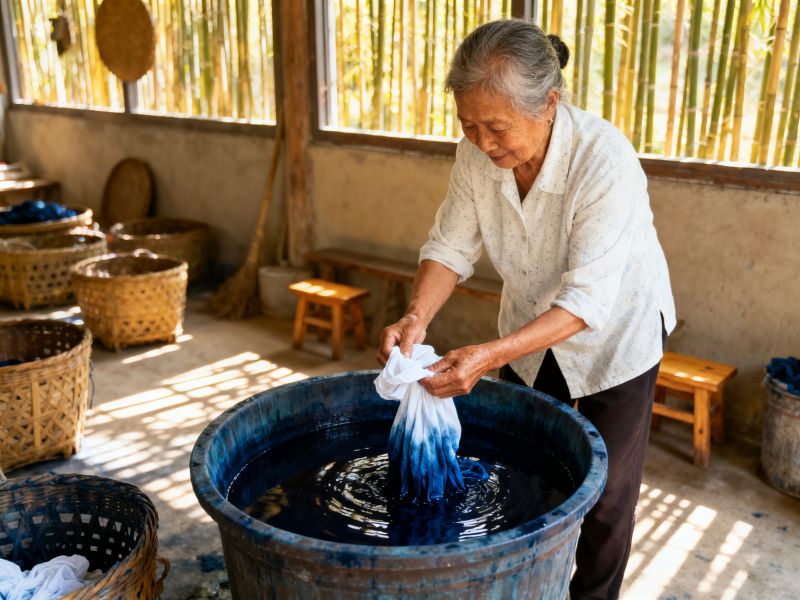
What makes Ma Mei unusual isn't the craft alone—it's her refusal to scale. In 2018, a Japanese fashion brand offered her a contract for 5,000 scarves a year. She turned it down. "They wanted four colors, all fast," she recalled, shaking her head. "Fast means chemical dye. That's not what I do." Instead。she started training local women, many of them mothers who had never held a regular job. Today, her cooperative exports small batches to twelve countries. The output is deliberately capped at 200 pieces per month. Ma Mei keeps the books in a worn notebook, tallying orders by hand.I asked her about the word "revival." She winced. "Revival suggests it was dead," she said. "My grandmother was dyeing until she was eighty-two. It never died. It just got quiet." That distinction matters. Ma Mei isn't preserving a museum piece;she's running a business with a waiting list. Her oldest trainee, a woman named Auntie Luo, is sixty-seven and now teaches the younger workers how to read indigo fermentation by smell. "Ma Mei gave us back our hands。" Auntie Luo told me, not looking up from a half-finished pattern. It was the most direct praise I heard all week.You won't find Ma Mei on social media. Her daughter handles the occasional WeChat order. The workshop has no sign. But the quiet is the point. In an economy obsessed with speed, Ma Mei's stubborn slowness is a kind of argument—that some things, like indigo, like trust, like a good blue。only deepen when you refuse to hurry. I left with a small square of cloth, unevenly dyed. She apologized for the streak. I didn't tell her that the streak was my favorite part.